Class definition
Aerial robots move through the air (IFR type C: fly C1, hover C2), though IFR generally avoids drones in its statistics. [A1]
DJI Matrice 400 and Matrice 350 RTK — covered below.
Different payload and endurance definitions; no primary sheet linked here.
DJI Matrice 400 vs Matrice 350 RTK
M400 endurance includes an H30T gimbal; M350 endurance has no payload, so they stay on separate rows. Battery energy is per pack, not an aircraft total. GNSS cells retain DJI’s constellation conditions.
| Metric | Matrice 400 | Matrice 350 RTK |
|---|---|---|
| Mass & geometry | ||
| Max takeoff weight# | 15.8 kg [M1] | 9.2 kg [M2] |
| Payload at named mount# | 6 kg (third gimbal port, sea level) [M1] | 960 g (single downward gimbal) [M2] |
| Dimensions (unfolded, L × W × H)# | 980 × 760 × 480 mm [M1] | 810 × 670 × 430 mm [M2] |
| Endurance — the two figures are measured differently and stay apart | ||
| Flight time — loaded# | 59 min, with H30T at 10.67 kg total [M1] | — |
| Flight time — no payload# | — | 55 min, ~8 m/s, no payload, no wind, to 0 % [M2] |
| Battery — per pack, not summed across packs | ||
| Battery model# | TB100 [M1] | TB65 [M2] |
| Packs per aircraft# | not stated on the support page [M1] | two, in the flight-time note [M2] |
| Capacity# | 20,254 mAh [M1] | 5880 mAh [M2] |
| Nominal voltage# | 48.23 V [M1] | 44.76 V [M2] |
| Maximum charge voltage# | 54.6 V [M1] | — |
| Cell type# | Li-ion 13S [M1] | Li-ion [M2] |
| Energy per pack# | 977 Wh [M1] | 263.2 Wh [M2] |
| Pack mass# | 4720 ± 20 g [M1] | ≈1.35 kg [M2] |
| Charging temperature# | 5–45 °C [M1] | — |
| Flight envelope & protection | ||
| Maximum speed# | 25 m/s [M1] | 23 m/s [M2] |
| Wind resistance# | 12 m/s [M1] | 12 m/s [M2] |
| Protection# | IP55 [M1] | IP55 [M2] |
| Operating temperature# | −20 to 50 °C [M1] | −20 to 50 °C [M2] |
| Navigation & interfaces | ||
| GNSS constellations (aircraft)# | GPS + Galileo + BeiDou + GLONASS; GLONASS only with the RTK module enabled [M1] | GPS + GLONASS + BeiDou + Galileo [M2] |
| RTK accuracy (RTK FIX)# | 1 cm + 1 ppm H; 1.5 cm + 1 ppm V [M1] | 1 cm + 1 ppm H; 1.5 cm + 1 ppm V [M2] |
| RTK heading# | supported, better than 2° [M1] | — |
| ADS-B# | ADS-B In receiver with two antennas; reception up to 20 km [M1] | — |
| Ports# | E-Port V2 ×4 at the underside, 120 W each; USB-C debug ×1 (USB 2.0); cellular dongle 2 interface ×2 [M1] | not published on the specs page [M2] |
| Link range# | — | 20 km FCC; 8 km CE [M2] |
Simulated flight recording
One recorded flight of a small research quadrotor in simulation. It is not an enterprise multirotor and none of its figures belong in the table above.
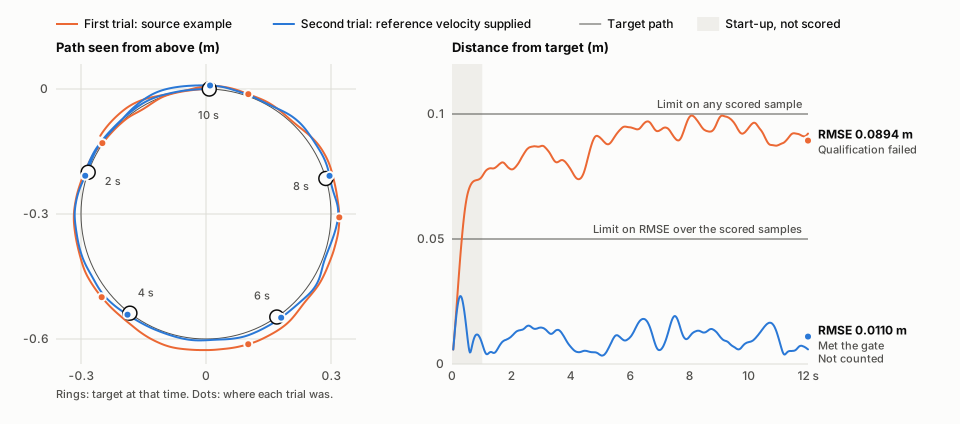
A simulated Crazyflie 2.X follows a 0.3 m circle for twelve seconds in PyBullet under the PID controller shipped with gym-pybullet-drones. [R1]
The flight is scored against a tracking-accuracy gate written before the first trial: RMSE at most 0.05 m.
Qualification failed. The first trial measured 0.0894 m: the example gives its controller no target velocity, so the drone trails its target by about half a second.
A second trial, declared after that failure, supplies the velocity to the unchanged controller and met the same gate at 0.0110 m. It is not counted as a pass.
The protocol’s rule against changing the controller to obtain a pass was amended after the failure; what was fixed beforehand is set out with the recording.